


Theodoor Rombouts
b. 1597, Antwerp, Belgium
d. 1637, Antwerp, Belgium
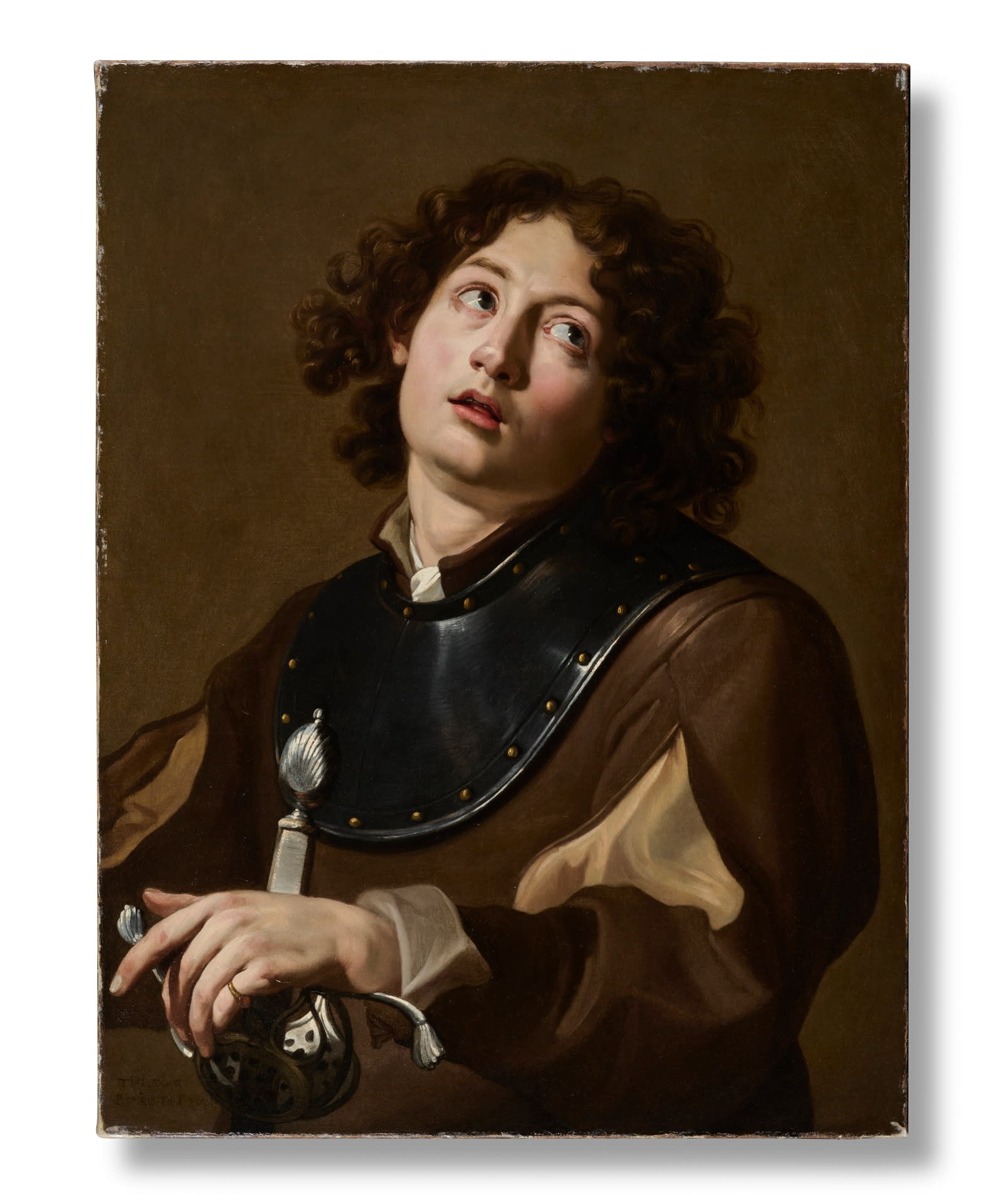
A Young Soldier
1624
Oil on canvas
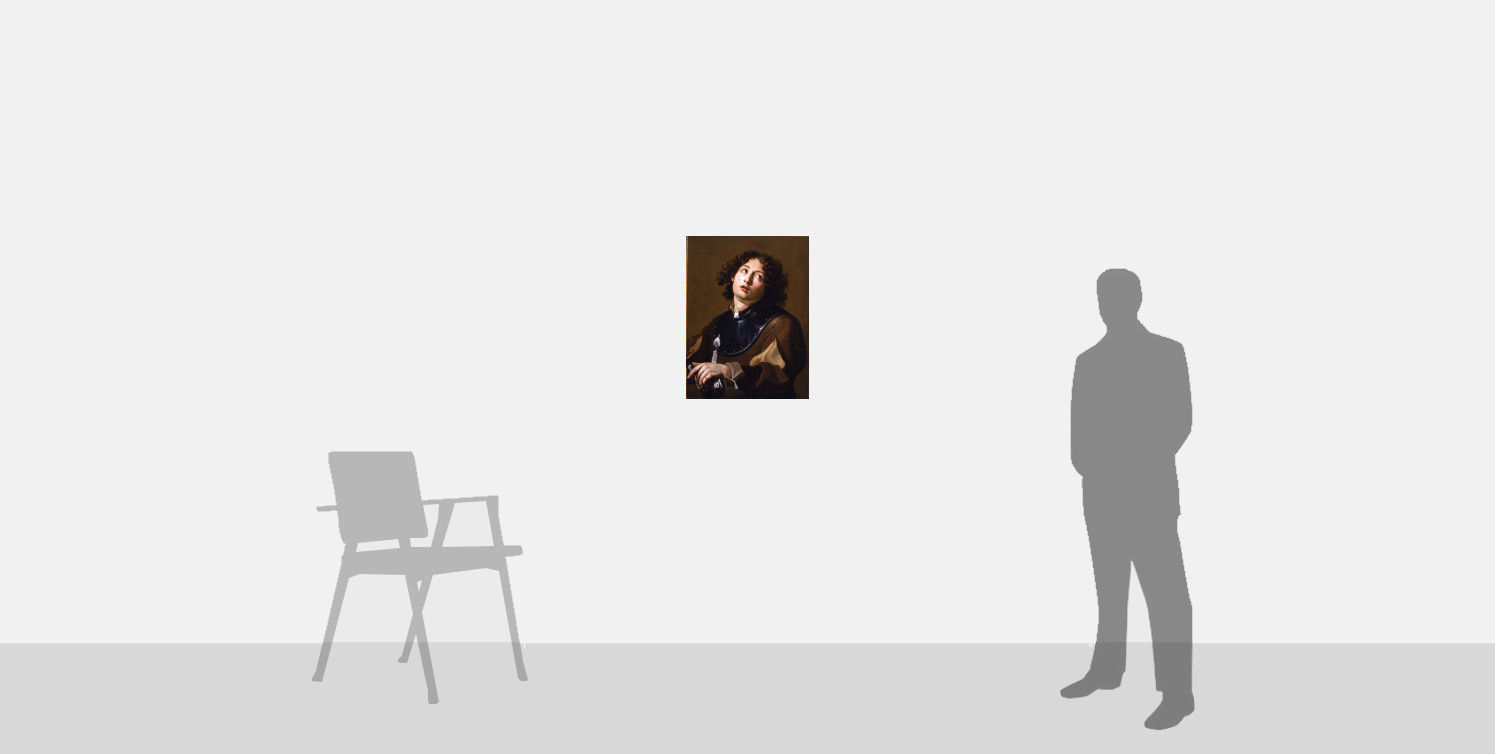
H 75.5 x 57.5 cm (29 3/4 x 22 5/8 in).
With frame: 93.7 x 75.5 x 6.5 cm (36 7/8 x 29 3/4 x 2 1/2 in)
Provenance
with Marco Voena,
Koelliker collection, Milan.
Literature
C. Wright, French, Dutch and Flemish Caravaggesque Paintings from Koelliker Collection, London 2007, pp. 58–59.
C. Wright In Pursuit of Caravaggio, exhibition catalogue, Robilant+Voena, London, 2016–17, pp. 62–63.
Description
The Antwerp painter Theodoor Rombouts was the leading Flemish representative of the Caravaggesque movement. After training in his native city with Abraham Janssens, Rombouts travelled to Rome in 1616 and remained there until 1625, joining the circle of international artists who had readily embraced Caravaggio’s revolutionary naturalism, tenebrism, and penchant for genre subjects.
The present painting depicts a soldier, his beringed hand gracefully poised upon the hilt of a rapier or parrying dagger, his neck arched and his mouth open, as if to speak, in a pose reminiscent of Caravaggio’s famous Boy with a Basket of Fruit (ca. 1593, Galleria Borghese, Rome). Following the example of the Utrecht Caravaggisti, especially Dirck van Baburen and Gerrit van Honthorst, Rombouts painted a number of single-figure canvases depicting musicians and drinkers, perhaps the most striking of which is the Lute Player, dated to around 1620, now in the Philadelphia Museum of Art. Meanwhile, the figure of the bravo, or soldier of fortune, is a familiar type from the Caravaggesque repertoire, and often featured in scenes of drinking, gambling, and trickery. As Cesare Vecellio noted in his costume manual, published in Venice in 1590: “these bravi or sbricchi…are always duelling…they serve this or that [master] for money, swearing and bullying without provocation, and committing all kinds of scandals and murders.” Yet, the figure in the present canvas, with his upturned gaze and facial expression suggestive less of soldierly prowess or depraved misadventure than of divine inspiration, seems more of apiece with depictions of saints rather than sinners. Indeed, in another work ascribed to Rombouts by Benedict Nicolson, a single figure of Saint Sebastian (then in the collection of Dr John A. Cauchi Collection, Rabat, Malta) is shown with the very same upward gaze. Thus, perhaps the figure here is not a debauched bravo of Caravaggesque tradition, but instead a martial saint, such as Martin, George, or Florian.
Rather unusually for Rombouts, the work is not only signed but also bears a date of 1624, placing near the end of the artist’s sojourn in the Eternal City. Indeed, only two other paintings by the artist are likewise inscribed with dates, the Concert in the Galleria d’Arte Antica, Rome, of 162(5), and the significantly later Backgammon Players in the North Carolina Museum of Art in Raleigh, of 1634. Especially compelling is the artist’s treatment of the metal surfaces, from the play of light across the breast plate to the crisp contours of the sword’s hilt. The elegance with which Rombouts had rendered the face and hand, the smooth handling of the figure’s leather jerkin with its slashed sleeves, and the warm light which pervades the picture plane seem to anticipate the more refined direction his art would take in the years following his return from Rome, when his palette became paler and his lighting more diffuse. At the same time, it is possible that Rombouts was in fact looking back in time, to the example of his Flemish compatriot Rubens, several of whose works were available for study in Roman churches, including the Madonna della Vallicella (ca. 1606–8) in the Chiesa Nuova, which includes a number of curly-haired, boyish angels not dissimilar in visage and expression to Rombouts’ soldier and possible saint.
The present work is promised to the forthcoming exhibition on Rombouts, planned by the Museum of Fine Arts, Ghent, 22 January–23 April 2023.
The artwork described above is subject to changes in availability and price without prior notice.
Where applicable ARR will be added.