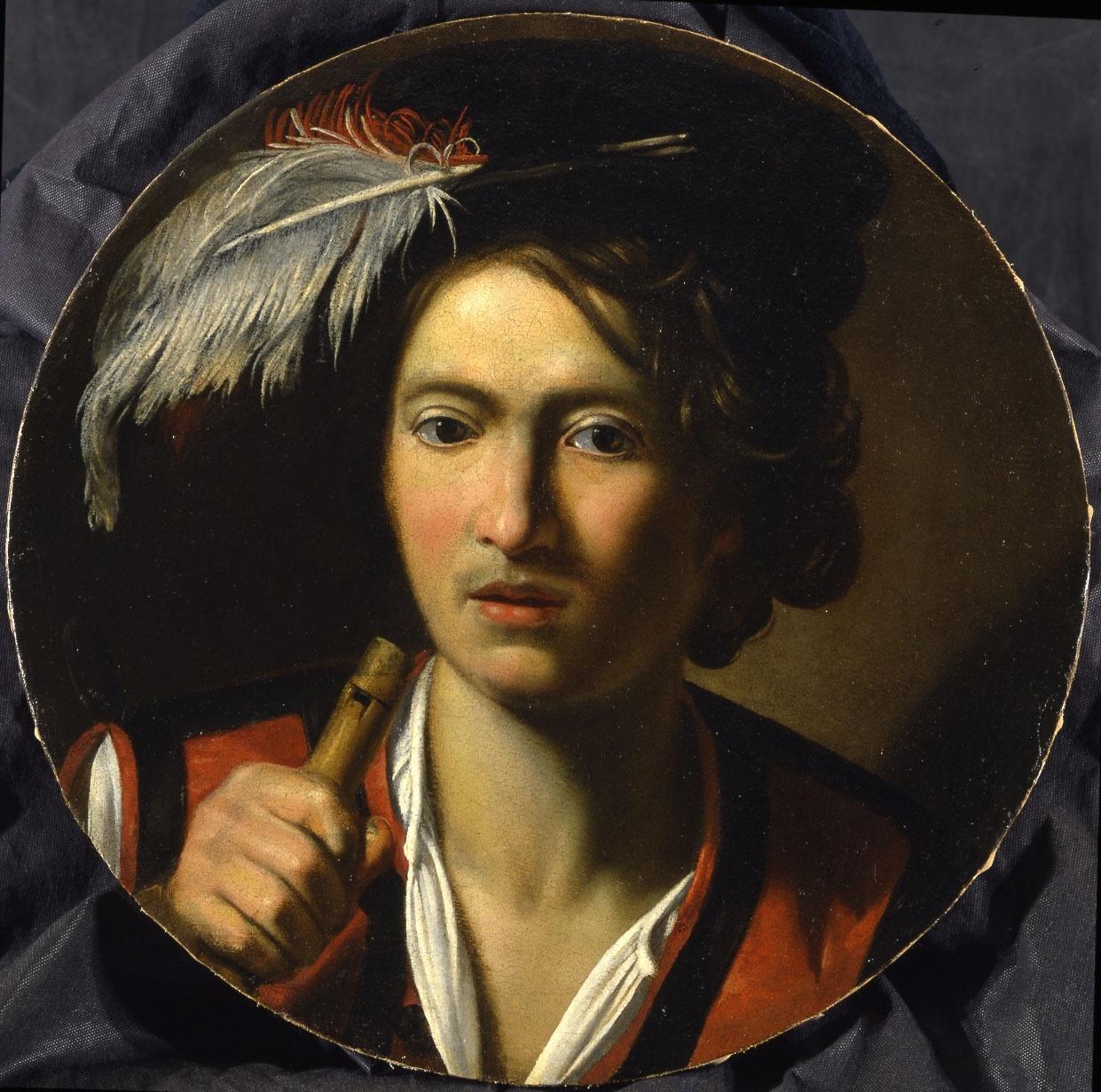

Nicolas Regnier
b. 1591, Maubeuge, France
d. 1667, Venice, Italy
A Flute Player
1610s
Oil on canvas
D: 49.5 cm (19 1/2 in.)
Provenance
(sold Sotheby’s, London, 12 July 2001, lot 15),
with Galerie Giovanni Sarti, Paris,
Koelliker collection, Milan.
Literature
A. Lemoine, 'L’iter di un caravaggesco nordico: Nicolas Regnier e il movimento naturalista', Paragone 30 (601), 2000, pp. 43–72.
A. Lemoine, Nicolas Regnier (alias Niccolò Renieri) ca. 1588–1667. Peintre, collectioneur et merchand d’art, Paris, 2007, pp. 212–13, no. 2.
Description
With bright feathers in his hat and his wooden flute clasped firmly in his hand, Nicolas Régnier’s flute player captures the viewer with his gentle yet enigmatic gaze. This sensitive portrait is one of the very first works Régnier painted in this style, completed shortly after the artist’s arrival in Rome.
The exact date of Régnier’s arrival in Rome is
unknown. The first documents confirming his presence are the Stati delle Anime of the parish of
Sant’Andrea delle Fratte from 1620, but it is highly probable that Régnier
arrived some years earlier, most likely in 1617. Gianni Papi has suggested a
first trip to Rome as early as 1610, but Annick Lemoine rejects the
identification of Régnier with the “Signore Niccolò Ranere Fiammingo” mentioned
in a document from 1610.
According to Lemoine, Régnier’s formative education took place in Antwerp in
the atelier of Abraham Janssens between 1610 and 1612, but his first known
works came after his arrival in Rome, where he soon began to paint in a style influenced
by the models of Caravaggio and his followers active in Rome during the second
decade of the seventeenth century. Régnier’s first works were portraits,
characterful heads of musicians or card players, as well as genre scenes
clearly indebted to Manfredi’s paintings and Caravaggio’s bravi.
In the early years of his Roman period, Régnier worked exclusively on small-scale
paintings, mostly “quadro da testa” such
as the present picture, or the very similar Head
of a Young Man now in the Pushkin Museum in Moscow (fig. 1). Over a very
short period he achieved great success and caught the eye of sophisticated collectors
such as the Marchese Vincenzo Giustiniani, a patron of Caravaggio during his
Roman years. Thanks to Giustianini’s patronage, Régnier was able to paint more
ambitious compositions such as Bacchus,
Homer, the Supper at Emmaus, and Saint
John the Baptist, all commissioned by Giustiniani (cfr. Lemoine 2007, pp.
218–38, nos. 11, 28, 33, 35). In 1624 he was admitted to the Virtuosi del
Pantheon, and shortly after was elected as a member of the famous Accademia di
San Luca, the culmination of his Roman career, before his move to Venice in
1626.
The artwork described above is subject to changes in availability and price without prior notice.